

When disaster strikes Wyoming, each county needs communications capabilities tailored to its unique geography, infrastructure, and operational requirements. The Wyoming Auxiliary Communications Service (WYACS) works alongside County Coordinators for Emergency Management to build county-specific auxiliary communications teams and resources—while simultaneously creating pathways for seamless inter-county ACS cooperation when emergencies exceed local capacity.
County-Focused Team Building
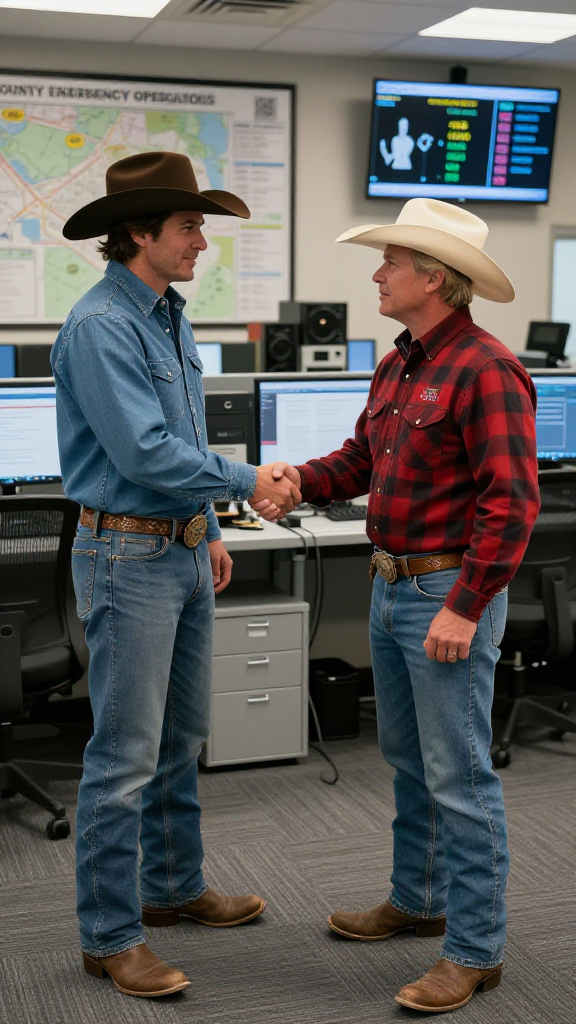 WYACS recognizes that effective emergency communications requires more than a statewide volunteer roster. Each Wyoming county faces distinct challenges: mountainous terrain that blocks VHF signals, vast distances between communities, different population densities, and varying emergency management structures. WYACS partners with County Emergency Managers to develop localized ACS programs that address these specific needs.
This county-centric approach means:
- Tailored volunteer recruitment that targets residents familiar with local geography and communication dead zones
- County-specific equipment and infrastructure recommendations based on terrain analysis and coverage requirements
- Localized training scenarios that reflect the actual emergencies each county faces, from wildfire evacuation routes to winter storm isolation patterns
- Direct integration with county Emergency Operations Centers (EOCs), ensuring volunteers understand local protocols and chain of command
WYACS handles the heavy lifting of volunteer vetting, credentialing, and training administration, allowing counties to focus on mission requirements rather than program management overhead.
The AUXCOMM Model: Beyond ARES and RACES
While many counties are familiar with Amateur Radio Emergency Service (ARES) and Radio Amateur Civil Emergency Service (RACES), these programs only touch the surface of what professional auxiliary communications can offer. ARES provides a nationwide volunteer framework, and RACES offers a structured amateur radio service for civil defense, but both operate within limitations that can leave gaps in emergency management capabilities.
The AUXCOMM (Auxiliary Communications) model, developed by the Cybersecurity and Infrastructure Security Agency (CISA), represents a more comprehensive approach. Unlike ARES and RACES, which focus primarily on amateur radio operations, AUXCOMM encompasses the full spectrum of backup communications—including HF, VHF, UHF, digital modes, mesh networking, and emergency data systems—integrated directly into the Incident Command Structure as Technical Specialists (THSP).
WYACS brings this complete AUXCOMM framework to Wyoming counties, providing capabilities that extend far beyond traditional amateur radio support.
SHARES: The Organized Federal Resource
One of the most significant advantages WYACS offers counties is coordination of their access to SHAred RESources (SHARES) High Frequency Radio Program, administered by CISA under DHS. While ARES and RACES provide valuable volunteer resources, SHARES delivers a more organized and often more beneficial resource for County Emergency Management Agencies facing critical communications failures.
SHARES provides:
- Federal backup communications when landline and cellular systems fail completely
- Access to government HF networks, including the 5 MHz channels authorized specifically for federal emergency communications
- Interoperability with amateur stations through standardized protocols and trained operators
- Direct connection to federal emergency management resources during major disasters
WYACS trains county volunteers in SHARES protocols, giving County Emergency Managers access to government communications infrastructure that amateur radio programs alone cannot provide. When primary systems fail and county operations require coordination with state and federal agencies, SHARES-trained WYACS volunteers bring professionally managed, federally authorized communications capabilities to the incident.
Inter-County ACS Cooperation Made Easier
Wyoming's geography demands regional thinking. No single county operates in isolation during major emergencies. WYACS builds interoperability into every county program it develops, making multi-county ACS cooperation seamless when resources must span jurisdictional boundaries.
Through standardized training, common equipment recommendations, and unified protocols, WYACS ensures that when one county's resources are overwhelmed, vetted communicators from neighboring jurisdictions can integrate immediately into operations without compatibility issues or command confusion. County ACS Coordinators trained by WYACS share common operational language, certification standards, and deployment procedures—eliminating the friction that often complicates mutual aid requests.
WYACS maintains relationships with the Wyoming Office of Homeland Security, the Wyoming Department of Transportation, and county emergency managers statewide, serving as the coordination hub that facilitates resource sharing across county lines when emergencies demand regional response.
Comprehensive Training for County Leadership
WYACS doesn't just recruit volunteers—it develops County ACS Coordinators who serve as local communications leaders within each emergency management agency. These coordinators undergo rigorous vetting and comprehensive training that includes:
- FEMA NIMS/ICS Certification ensuring they operate as professional partners within the emergency management structure
- AUXC Position Task Books providing standardized qualification pathways recognized nationwide
- SHARES protocol training enabling access to federal communications resources
- Winlink digital messaging, AREDN mesh networking, and interoperable systems expertise that extends beyond traditional radio operations
- EOC etiquette and professional deployment standards ensuring seamless integration with paid emergency management staff
This investment in county-level leadership ensures each jurisdiction maintains professional-grade auxiliary communications capabilities without relying on external direction during active emergencies.
The Complete Communications Resource
WYACS draws from Wyoming's diverse communications expertise to build county teams capable of supporting the full spectrum of emergency data needs—from situational reporting and resource tracking to digital imagery and interoperable messaging with state and federal systems. Whether the need is voice communications in remote backcountry, data networks for incident command posts, or HF links to federal agencies, WYACS-developed county teams bring the appropriate capabilities.
For County Emergency Managers, this means access to organized, trained, and vetted auxiliary communications capacity that integrates smoothly with existing operations, follows professional standards, and meets the accountability requirements of modern emergency management—without the administrative burden of building and maintaining such a program independently.
Conclusion
WYACS delivers a dual benefit to Wyoming counties: localized ACS programs built to address specific jurisdictional needs, and regional interoperability that activates when emergencies exceed county boundaries. By moving beyond the limitations of traditional ARES and RACES programs to embrace the full AUXCOMM framework—including organized federal resources like SHARES—WYACS ensures County Emergency Management Agencies have professional-grade auxiliary communications capabilities ready when disaster strikes.
For counties seeking to develop or enhance their auxiliary communications programs, WYACS offers a partnership model that combines local autonomy with statewide coordination, bringing national-standard training and proven volunteer management systems to the unique challenges of Wyoming emergency management.